


Baby Care
4 days ago
Q: Meri gudiya ko kon kon si date pr vacation lgao
 2Answer


Quick Answer
Indian babies get vaccines at birth, 6, 10 and 14 weeks, 9 to 12 months, 16 to 24 months and 5 to 6 years under the government's Universal Immunization Programme, free at government centres. The IAP schedule, followed by many private paediatricians, adds paid vaccines such as flu, typhoid, hepatitis A and chickenpox. Ask your paediatrician which suits your baby.
If you are holding your baby's vaccination card and wondering what all the short forms mean, or why your friend's paediatrician gave different injections, you are not alone. India has two main schedules, and both are designed to protect your baby. Here is the complete chart for each, what every vaccine protects against, what to do if you miss a dose, and how to care for your baby after the shots.
UIP or IAP: what is the difference?
Government schedule (UIP) | IAP schedule | |
|---|---|---|
Who sets it | Ministry of Health and Family Welfare, Government of India | Indian Academy of Pediatrics (IAP), Advisory Committee on Vaccines and Immunization Practices |
Cost | Free at government health centres | Paid, given mostly at private clinics and hospitals |
What it covers | 12 vaccine-preventable diseases | All UIP diseases, plus extra vaccines such as flu, typhoid, hepatitis A, chickenpox and HPV |
Who follows it | Government hospitals, PHCs, anganwadi sessions | Many private paediatricians |
The Universal Immunization Programme reaches about 2.54 crore newborns every year, free of cost, and protects against 12 diseases. The IAP schedule covers the same diseases with some extra vaccines and boosters. Both are safe and effective. The difference is mainly in the number of diseases covered and the cost.
Government baby vaccination chart (UIP)
This is the current National Immunization Schedule, as published by the Government of India in March 2026.
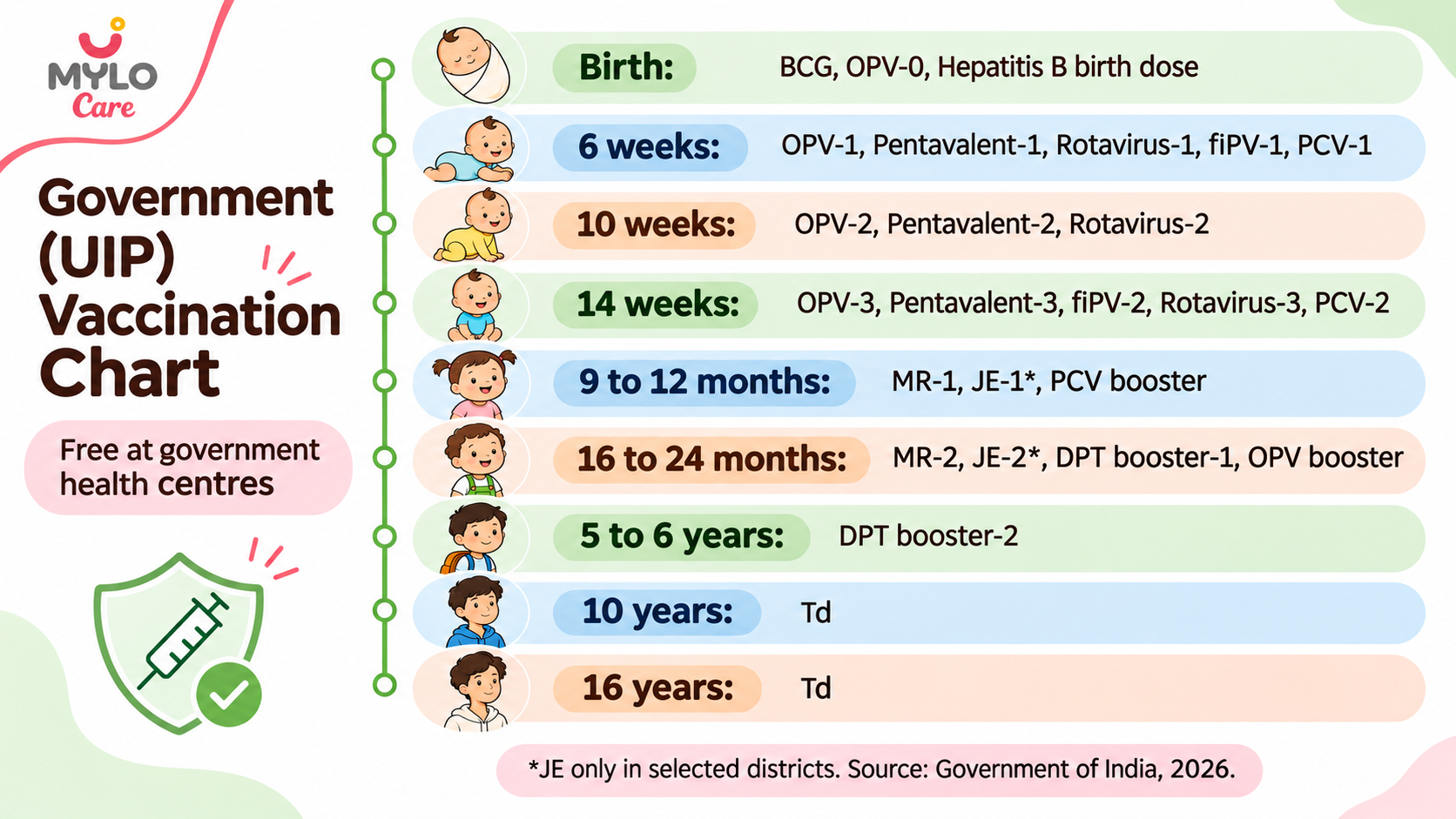
Age | Vaccines given (free) |
|---|---|
Birth | BCG, OPV-0 (oral polio), Hepatitis B birth dose |
6 weeks | OPV-1, Pentavalent-1, Rotavirus (RVV)-1, fIPV-1 (injectable polio), PCV-1 (pneumococcal) |
10 weeks | OPV-2, Pentavalent-2, RVV-2 |
14 weeks | OPV-3, Pentavalent-3, fIPV-2, RVV-3, PCV-2 |
9 to 12 months | Measles-Rubella (MR)-1, JE-1 (in some districts), PCV booster |
16 to 24 months | MR-2, JE-2 (in some districts), DPT booster-1, OPV booster |
5 to 6 years | DPT booster-2 |
10 years | Td (tetanus and adult diphtheria) |
16 years | Td |
A few things to know:
Pentavalent is one injection that protects against 5 diseases: diphtheria, pertussis (whooping cough), tetanus, hepatitis B and Hib.
JE (Japanese Encephalitis) vaccine is given only in districts where the disease is common.
Vitamin A is also given with MR-1 at 9 months, and then every 6 months up to 5 years, according to the National Health Mission.
HPV vaccine for cervical cancer prevention was added in 2026 for 14-year-old girls, free at government facilities, according to the Government of India.
IAP vaccination chart (2025)
This is the latest routine schedule recommended by the IAP Advisory Committee on Vaccines and Immunization Practices, published in Indian Pediatrics in April 2026. It replaces the 2023 schedule.
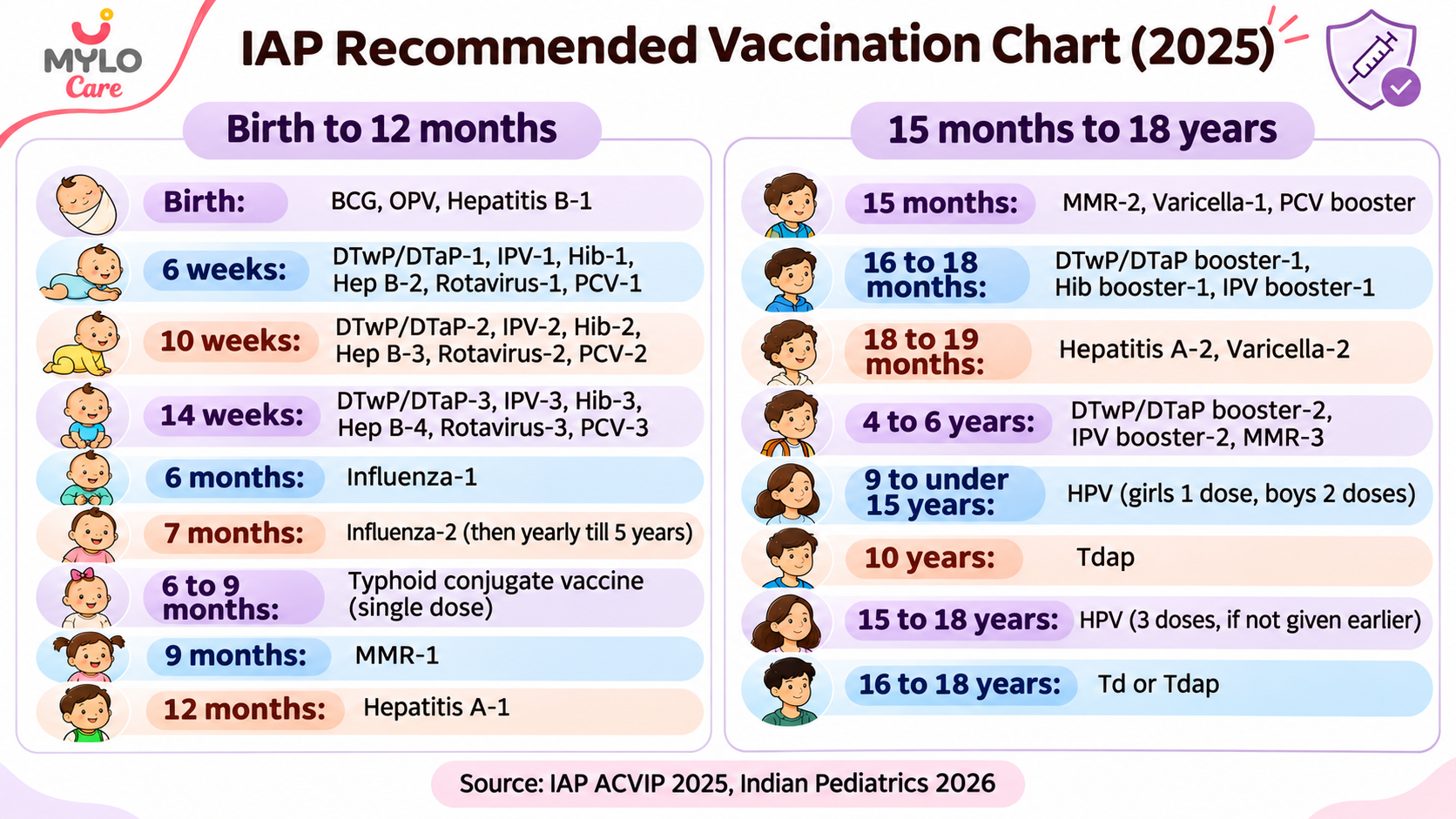
Age | Vaccines | Notes |
|---|---|---|
Birth | BCG, OPV, Hepatitis B-1 | Hepatitis B within 24 hours of birth |
6 weeks | DTwP or DTaP-1, IPV-1, Hib-1, Hep B-2, Rotavirus-1, PCV-1 | Often given as one combination injection |
10 weeks | DTwP or DTaP-2, IPV-2, Hib-2, Hep B-3, Rotavirus-2, PCV-2 | |
14 weeks | DTwP or DTaP-3, IPV-3, Hib-3, Hep B-4, Rotavirus-3, PCV-3 | The third rotavirus dose is not needed for one brand (RV1) |
6 months | Influenza (flu)-1 | |
7 months | Influenza-2 | Then once every year until 5 years, usually before the monsoon |
6 to 9 months | Typhoid conjugate vaccine | Single dose, no booster recommended |
9 months | MMR-1 (measles, mumps, rubella) | |
12 months | Hepatitis A-1 | One dose only for the live vaccine |
15 months | MMR-2, Varicella (chickenpox)-1, PCV booster | |
16 to 18 months | DTwP or DTaP booster-1, Hib booster-1, IPV booster-1 | |
18 to 19 months | Hepatitis A-2, Varicella-2 | Hepatitis A-2 only for the inactivated vaccine |
4 to 6 years | DTwP or DTaP booster-2, IPV booster-2, MMR-3 | |
9 to under 15 years | HPV | Girls: 1 dose. Boys: 2 doses, 6 months apart |
10 years | Tdap | |
15 to 18 years | HPV, 3 doses | If not given earlier, and for children with weak immunity at any age |
16 to 18 years | Td or Tdap |
What changed in the IAP 2025 schedule?
The baby schedule from birth to 6 years is the same as in 2023. The 2025 update changed a few things:
Flu vaccine: the four-strain (quadrivalent) flu vaccines can now be replaced with three-strain (trivalent) vaccines, because one flu B strain is no longer circulating.
HPV vaccine: healthy girls aged 9 to under 15 years can now have a single dose. Boys of the same age still need 2 doses, 6 months apart.
RSV protection (nirsevimab): this antibody injection against respiratory syncytial virus is not recommended for all babies yet. The IAP suggests it only for high-risk babies, after discussion with parents.
Typhoid vaccine: a single dose from 6 months is still enough, with no booster.
Rabies after an animal bite: a 5-dose injection schedule on days 0, 3, 7, 14 and 28, along with rabies immunoglobulin or antibodies depending on the type of bite.
What extra vaccines does the IAP schedule include?
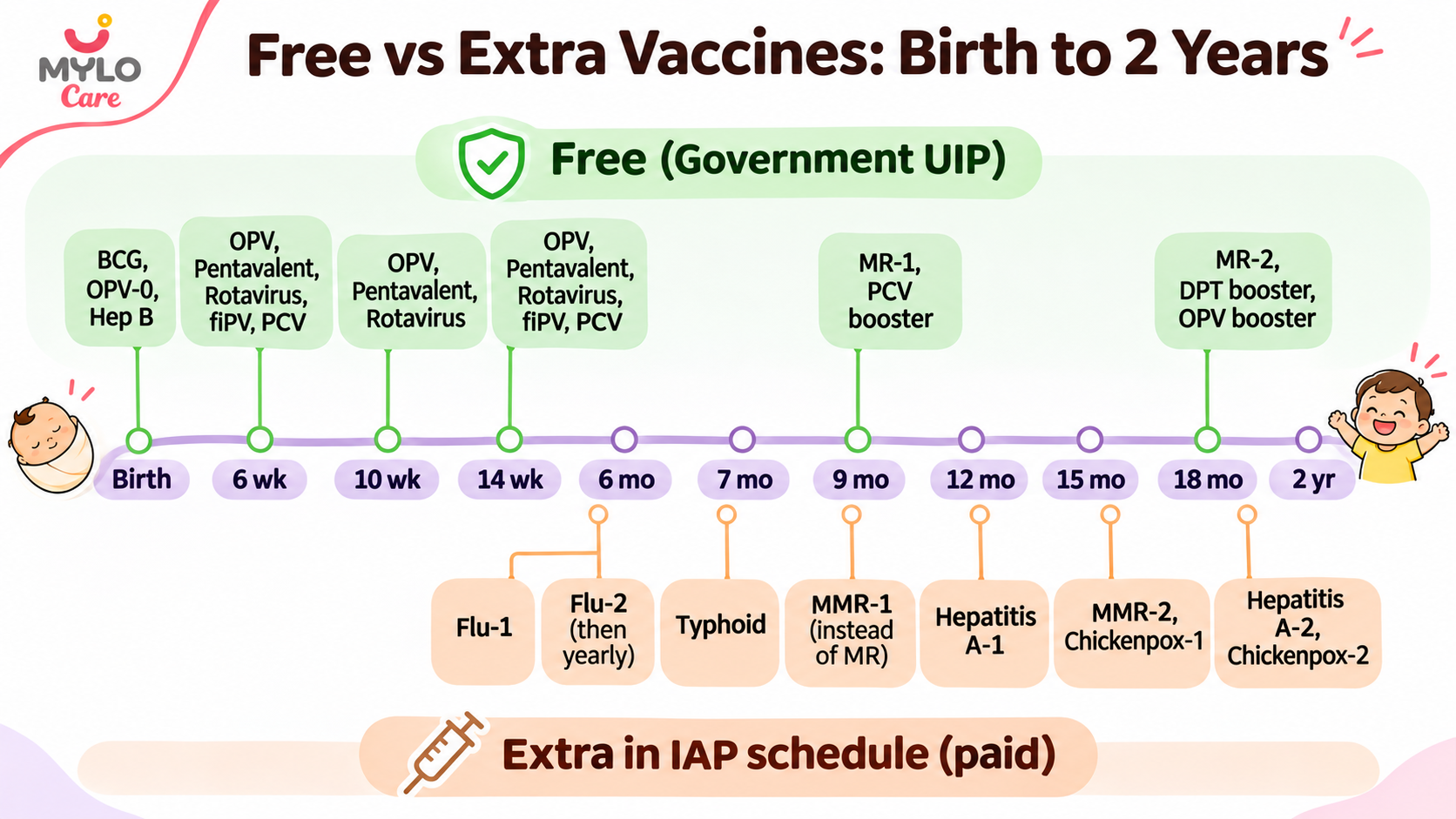
Compared with the government schedule, the IAP schedule adds or changes:
Flu (influenza) vaccine: 2 doses at 6 and 7 months, then once a year until 5 years
Typhoid conjugate vaccine: 1 dose between 6 and 9 months
Hepatitis A vaccine: at 12 months (and 18 to 19 months for the inactivated vaccine)
Chickenpox (varicella) vaccine: at 15 months and 18 to 19 months
MMR instead of MR: adds protection against mumps, with 3 doses (9 months, 15 months, 4 to 6 years)
HPV vaccine: for girls (1 dose) and boys (2 doses) from 9 to under 15 years
Tdap at 10 years and Td or Tdap at 16 to 18 years
What does each vaccine protect against?
Vaccine | Protects against |
|---|---|
BCG | Severe forms of childhood tuberculosis (TB) |
OPV and IPV (fIPV) | Polio, which can cause lifelong paralysis |
Hepatitis B | Hepatitis B, a liver infection |
Pentavalent or DTP | Diphtheria, pertussis (whooping cough) and tetanus. Pentavalent also covers hepatitis B and Hib |
Hib | Haemophilus influenzae type b, which can cause pneumonia and meningitis |
Rotavirus (RVV) | Rotavirus, a common cause of severe diarrhoea in babies |
PCV | Pneumococcal disease, including pneumonia and meningitis |
MR or MMR | Measles and rubella (MMR also covers mumps) |
JE | Japanese encephalitis, a brain infection spread by mosquitoes |
Td or Tdap | Tetanus and diphtheria (Tdap also covers pertussis) |
Influenza | Seasonal flu |
Typhoid conjugate vaccine | Typhoid fever |
Hepatitis A | Hepatitis A, a liver infection spread through contaminated food and water |
Varicella | Chickenpox |
HPV | Human papillomavirus, which can cause cervical and other cancers |
The descriptions of the UIP diseases are based on the Government of India list of diseases covered by the programme.
Can you mix the government and IAP schedules?
Yes, and many families do. The IAP 2025 guidance itself says that if the combination vaccine with IPV is not affordable, the baby can be taken to a government facility for the primary doses as per the UIP schedule.
Polio doses work differently in the two schedules: the government gives oral polio drops plus 2 small fractional IPV injections, while the IAP schedule uses 3 full IPV doses and boosters. If you switch between them, ask your paediatrician which polio doses your baby still needs.
If you plan to take some vaccines at a government centre and others privately, carry your vaccination card to every visit and tell your paediatrician which doses your baby has already had.
How much do baby vaccines cost in India?
All vaccines in the UIP schedule are free at government hospitals, primary health centres and immunisation sessions, according to the Government of India.
At private clinics and hospitals, you pay for each vaccine. Prices vary widely by brand, the number of diseases in a combination vaccine and the clinic itself. Ask your paediatrician for a cost estimate for the full first year so you can plan ahead.
What if your baby misses a vaccine dose?
Do not worry, and do not skip the rest. Talk to your paediatrician or visit a government health centre as soon as you can, and carry the vaccination card. In most cases the missed dose is simply given late, and the schedule continues from there.
Some vaccines have an upper age limit in the government programme. According to the National Health Mission:
Vaccine | Can be given up to |
|---|---|
BCG | 1 year of age |
OPV | 5 years of age |
Pentavalent | 1 year of age |
Rotavirus | 1 year of age |
Measles (MR) | 5 years of age |
This is why it is important to catch up on missed doses quickly.
How to keep track of your baby's vaccines
Keep the vaccination card safe and take it to every visit.
Register on U-WIN, the government's digital platform for immunisation registration, appointments and records, as described by the Government of India.
Use Mylo's free tool: the Immunization Scheduler gives your baby's due dates by birth date, for either the IAP or the government schedule.
Side effects after vaccination and how to care for your baby
Vaccines are very safe. The World Health Organization says side effects are usually minor and short-lived, such as soreness or a mild fever, and serious side effects are extremely rare.
According to UNICEF India, common reactions include:
redness, swelling or pain where the injection was given
a mild fever, usually starting the day after vaccination and lasting 1 to 3 days
fussiness, irritability or a smaller appetite for a day or two
after BCG, soreness or a little discharge at the injection site
To help your baby feel better:
Breastfeed or cuddle your baby during and after the injection.
Dress your baby in light, loose clothes.
Do not rub or press on the injection site.
Give paracetamol syrup for fever only in the dose your paediatrician advises.
Once your baby has settled and the soreness has eased, a calm daily care routine can help them relax. Mylo's Baby Wellness Kit | Baby Body Lotion + Tummy Roll-On + Baby Hair Oil + Baby Massage Oil + Diaper Rash Cream brings together a baby massage oil, body lotion, hair oil, tummy roll-on and diaper rash cream for everyday care. Do not apply oil, lotion or cream on the injection site unless your paediatrician advises it.
Our guide on soothing your baby after vaccination has more tips.
When should you call the doctor after a vaccine?
Contact your paediatrician if your baby has an unexpected reaction, as the WHO advises, or if:
the fever is high or lasts longer than 3 days
your baby cries inconsolably for hours
your baby is unusually drowsy, floppy or difficult to wake
the injection site becomes very swollen, hot or keeps oozing after a few days
Go to the nearest emergency department straight away, or call 112 or 108, if your baby has difficulty breathing, swelling of the face, lips or throat, or a fit (seizure). These can be signs of a severe allergic reaction, which is extremely rare.
Frequently Asked Questions
1. Which vaccines are given at 6 weeks? Under the government schedule: OPV-1, Pentavalent-1, Rotavirus-1, fIPV-1 and PCV-1. Under the IAP schedule: DTwP or DTaP-1, IPV-1, Hib-1, Hepatitis B-2, Rotavirus-1 and PCV-1, often as one combination injection plus oral rotavirus drops.
2. Which vaccines are given at 9 months? Under the government schedule: MR-1, JE-1 (in some districts), PCV booster and Vitamin A. Under the IAP schedule: MMR-1. The IAP typhoid vaccine is given between 6 and 9 months.
3. Is the IAP schedule better than the government schedule? Both protect your baby against serious diseases. The IAP schedule adds protection against a few more diseases, such as flu, typhoid, hepatitis A and chickenpox, which are paid vaccines. Your paediatrician can help you decide what suits your family and budget.
4. What is the difference between DTwP and DTaP? Both protect against diphtheria, tetanus and pertussis. DTwP uses whole-cell pertussis, and DTaP uses acellular pertussis. The IAP accepts either for the primary doses. Ask your paediatrician which one they recommend.
5. Are government vaccines free? Yes. All UIP vaccines are free at government health facilities and immunisation sessions.
6. My baby missed a vaccine. Do we need to start again? Usually not. Your doctor will normally give the missed dose and continue the schedule. Some vaccines have an upper age limit, so go as soon as you can.
7. Can my baby get more than one vaccine on the same day? Yes. Both schedules give several vaccines at the same visit, such as at 6, 10 and 14 weeks. This is planned and safe.
Related Articles
Is It Normal for Babies to Cry After Getting Vaccinated and Ways to Soothe Them
Vaccination in Pregnancy: The Complete Schedule for Pregnant Women
Related Products
Baby Wellness Kit | Baby Body Lotion + Tummy Roll-On + Baby Hair Oil + Baby Massage Oil + Diaper Rash Cream: an everyday baby care set with massage oil, body lotion, hair oil, tummy roll-on and diaper rash cream
References
Press Information Bureau, Government of India. Celebrating the Power of Vaccines (Universal Immunization Programme and National Immunization Schedule), March 2026. https://static.pib.gov.in/WriteReadData/specificdocs/documents/2026/mar/doc2026320830601.pdf
Shastri DD, Dhir SK, Rajsekhar B, et al. Indian Academy of Pediatrics (IAP) Advisory Committee on Vaccines and Immunization Practices (ACVIP): Recommended Immunization Schedule (2025) and Update on Immunization for Children Aged 0 Through 18 Years. Indian Pediatrics, 2026;63:311-324. https://www.indianpediatrics.net/may2026/311.pdf
National Health Mission. National Immunization Schedule (NIS) for Infants, Children and Pregnant Women. https://nhm.gov.in/New_Updates_2018/NHM_Components/Immunization/report/National_%20Immunization_Schedule.pdf
UNICEF India. Know your child's immunization schedule. https://www.unicef.org/india/know-your-childs-immunization-schedule
World Health Organization. Vaccines and immunization: vaccine safety. https://www.who.int/news-room/questions-and-answers/item/vaccines-and-immunization-vaccine-safety
Medical disclaimer: This article is for general information only and is not a substitute for advice from your paediatrician. Vaccine schedules can be updated, so please confirm your baby's schedule with your doctor or local health centre. so please confirm your baby's schedule with your doctor or local health centre.



Ask your question about baby care
Get expert answers within 5 minutes for FREE only on Mylo App

Posted In
Baby Care
4475045 Posts
Related Articles
क्या स्तनपान के दौरान पीरियड्स वापस आ सकते हैं?|(Can Periods Return While Breastfeeding In Hindi)
प्रसव के बाद बाल झड़ना तीन महीने में क्यों शुरू होता है? (Why Does Postpartum Hair Fall Begin Around Three Months In Hindi)

कैसे पता करें कि आपके बच्चे को पर्याप्त दूध मिल रहा है?|(How to Tell if Your Baby Is Getting Enough Milk In Hindi)
मेरे बच्चे का डायपर रात में क्यों लीक होता है?|Why Is My Baby's Diaper Leaking at Night In Hindi)
Related Topics


AWARDS AND RECOGNITION

Mylo wins Forbes D2C Disruptor award

Mylo wins The Economic Times Promising Brands 2022
AS SEEN IN













- Mylo Care: Effective and science-backed personal care and wellness solutions for a joyful you.
- Mylo Baby: Science-backed, gentle and effective personal care & hygiene range for your little one.
- Mylo Community: Trusted and empathetic community of 10mn+ parents and experts.


